
The furniture industry is moving toward more diverse materials and increasingly sophisticated surface designs. From kitchen cabinets and wardrobes to decorative wall panels and office furniture, manufacturers are combining engineered wood, plastic films, aluminum profiles and other materials to achieve better appearance and functionality.
However, combining different substrates also creates new challenges for bonding. Inadequate adhesion can result in peeling edges, surface bubbles and delamination, affecting both product quality and long-term durability.
Selecting a suitable furniture adhesive is therefore an important part of production planning. Manufacturers need to consider not only bonding strength but also material compatibility, processing temperature, viscosity and manufacturing efficiency.
1. Modern Furniture Materials Require More Specialized Bonding Solutions
MDF, PVC foam boards, PET films, PVC decorative films, acrylic sheets and aluminum profiles have different surface properties. Some materials are porous and absorb adhesive, while others have relatively low surface energy and require more specific bonding formulations.
These differences can affect adhesive wetting, initial adhesion and final bond strength.
For example, an adhesive designed primarily for wood-to-wood bonding may not perform consistently when used to laminate decorative plastic films onto engineered panels. Similarly, profile wrapping requires an adhesive that can maintain uniform coverage across shaped surfaces.
This is why manufacturers increasingly choose application-specific industrial furniture adhesives instead of relying on a single general-purpose formulation.
2. Why PUR Hot Melt Adhesive Is Used in Furniture Manufacturing
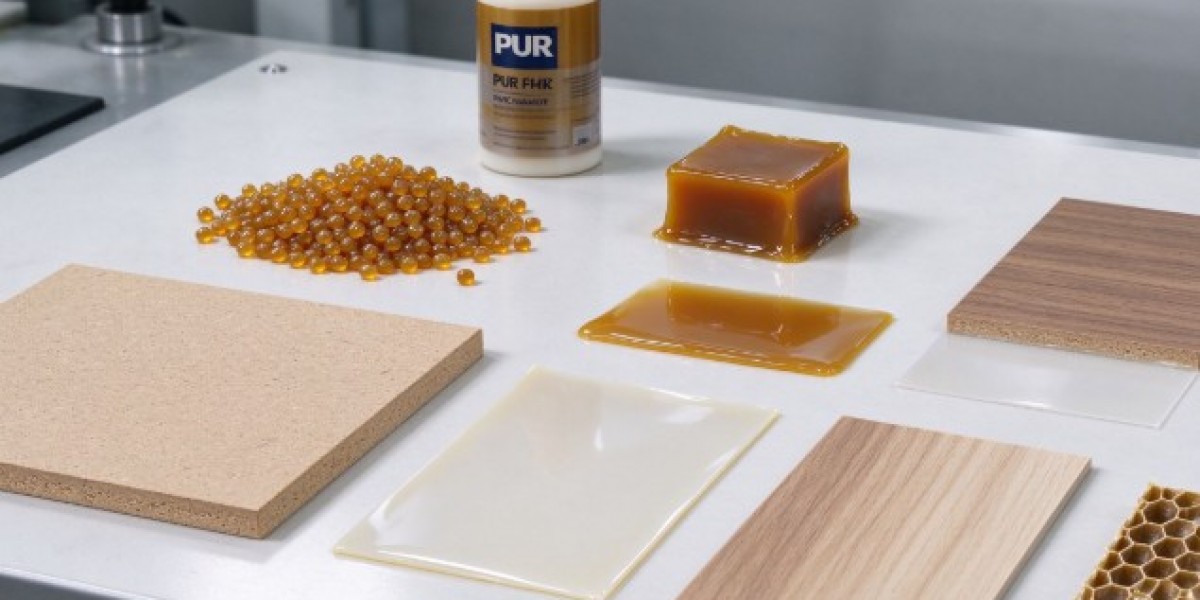
Polyurethane reactive (PUR) hot melt adhesive is widely applied in furniture lamination, edge banding and profile wrapping.
Unlike conventional thermoplastic hot melts, PUR adhesives undergo a moisture-triggered chemical reaction after application. This additional curing process forms a crosslinked structure that can provide durable bonding and improved moisture resistance when the adhesive is correctly selected and applied.
Its main advantages include:
Strong adhesion: Suitable formulations can bond a range of compatible wood-based and decorative materials.
Moisture resistance: Chemical crosslinking can improve resistance to moisture exposure.
Application flexibility: Different viscosity grades are available for different equipment and production processes.
Durable bonding: Appropriate formulations can help reduce peeling and delamination in finished furniture components.
Nevertheless, PUR performance depends on proper processing. Application temperature, coating weight, open time, substrate condition and curing environment should all be considered during production trials.
3. Four Important Applications of PUR Furniture Adhesive
Decorative Surface Lamination
Decorative lamination is commonly used for cabinet doors, wardrobe panels and furniture boards. Materials such as PET, PVC, acrylic sheets, wood veneer, aluminum foil and melamine paper may be bonded to compatible substrates, including MDF and PVC foam boards.
The challenge is achieving an even adhesive layer while preventing bubbles, wrinkles and localized separation.
Wuxi Laien Technology's LE-1216A-7E PT PUR hot melt adhesive is listed for bonding PET, PVC, acrylic sheets, wood veneer, aluminum foil and melamine paper to compatible substrates.
Its published technical specifications include:
Operating temperature: 120–150°C
Viscosity: 7,000 ± 2,000 mPa·s at 120°C
These characteristics make it a formulation worth evaluating for decorative furniture panel lamination.
Furniture Edge Banding
Edge banding protects exposed panel edges and creates a finished appearance for cabinets, desks and wardrobes. Poor bonding can cause edge strips to lift during transportation or daily use.
A suitable PUR hot melt adhesive for edge banding must match the edge material, panel substrate, application equipment and production speed.
Wuxi Laien Technology offers LE-1227B PUR hot melt adhesive for furniture edge-sealing applications.
Published specifications include:
Operating temperature: 120–160°C
Viscosity: 100,000 ± 20,000 mPa·s at 130°C
Available colors: Natural and white
Manufacturers should conduct trials with their actual edge materials and machinery to confirm coating performance and bonding consistency.
Profile Wrapping
Profile wrapping involves applying decorative films or veneers to shaped components, including PVC profiles, wood moldings and aluminum profiles.
Unlike flat-panel lamination, this process requires consistent adhesive distribution across curved surfaces and edges. Incorrect viscosity or inadequate wetting may lead to incomplete coverage and peeling.
The 1216A-7E BF PUR series from Wuxi Laien Technology is listed for wrapping PVC film, wood veneer and melamine paper onto compatible wood moldings, PVC profiles and aluminum profiles.
Its recommended operating temperature range is 120–150°C.
Honeycomb Panel Bonding
Honeycomb panels are used in lightweight furniture and interior applications. Their bonding requirements depend on panel construction, contact surfaces and production conditions.
Wuxi Laien Technology's LE-3317A PUR adhesive is listed for honeycomb panel and duct panel bonding.
Its published specifications include:
Operating temperature: 140–170°C
Viscosity: 25,000 ± 5,000 mPa·s at 140°C
The formulation should be evaluated against the actual panel structure and production process before full-scale application.
4. How Manufacturers Can Improve Adhesive Selection
Choosing an appropriate furniture adhesive requires a systematic evaluation rather than relying on product descriptions alone.
First, identify the substrates. Determine the exact materials being bonded, including their surface coatings, treatments and physical characteristics.
Second, review production conditions. Application equipment, operating temperature, line speed and pressing conditions can all influence bonding results.
Third, compare viscosity and application behavior. Adhesive viscosity affects flow, wetting and coating uniformity. Technical comparisons should use measurements taken at equivalent temperatures.
Finally, conduct practical bonding tests. Evaluate initial adhesion, final bond strength, edge integrity, surface appearance and resistance to relevant environmental conditions.
Testing with actual production materials is particularly important when introducing new decorative films or changing manufacturing equipment.
5. Why Supplier Technical Support Matters
A reliable furniture adhesive supplier should provide more than a product catalog. Consistent quality, technical documentation, sample availability and application recommendations are important for manufacturers seeking stable production results.
Wuxi Laien Technology provides PUR hot melt adhesive solutions for furniture manufacturing, including decorative lamination, edge sealing and profile wrapping.
Its product range covers different bonding applications, while sample evaluation and inspection procedures help customers assess product suitability before larger-scale procurement.
For furniture manufacturers working with increasingly diverse materials, technical communication with the adhesive supplier can help identify suitable formulations and reduce unnecessary production adjustments.
Conclusion
As furniture manufacturing continues to incorporate engineered boards, decorative films and composite materials, adhesive selection has become an important factor in finished-product quality.
PUR hot melt adhesive offers solutions for decorative lamination, edge banding, profile wrapping and honeycomb panel bonding. However, reliable results depend on matching the formulation with the substrate and production conditions.
By evaluating viscosity, operating temperature, material compatibility and actual bonding performance, manufacturers can improve production consistency and reduce common bonding defects.
For companies seeking PUR hot melt adhesive for furniture manufacturing, Wuxi Laien Technology offers application-oriented formulations that can be evaluated according to different production requirements.