
In chemical and materials manufacturing, achieving consistent dispersion is essential for product quality and production efficiency. Paints, industrial coatings, printing inks, adhesives, sealants, and pigment pastes all require effective mixing and particle distribution. However, their processing characteristics can vary significantly depending on viscosity, solid content, formulation structure, and the desired final properties.
One important equipment decision is whether to use a single shaft disperser or a double shaft disperser. Although both configurations are designed to support mixing and dispersion, they differ in how they generate shear and circulate materials throughout the mixing vessel.
For manufacturers handling increasingly complex formulations, selecting the appropriate configuration can influence dispersion uniformity, processing time, energy consumption, and overall production stability.
1. Understanding the Relationship Between Material Properties and Dispersion
Before comparing equipment configurations, manufacturers should understand how their materials behave during mixing.
A disperser uses mechanical energy to break down agglomerates, wet out powders, and distribute solid particles throughout a liquid medium. The effectiveness of this process depends on more than rotational speed. Material viscosity, particle characteristics, solids concentration, and circulation patterns all affect the final result.
For relatively fluid formulations, material can circulate more easily around the dispersing disc. However, as viscosity and solids content increase, movement throughout the vessel becomes more difficult. Some areas may experience intensive shear while other regions receive insufficient mixing.
This can lead to uneven dispersion, longer processing cycles, and inconsistent product properties.
Therefore, equipment selection should consider two complementary functions: localized high-shear dispersion and overall batch circulation.
2. Single Shaft Disperser: A Practical Solution for Conventional Formulations
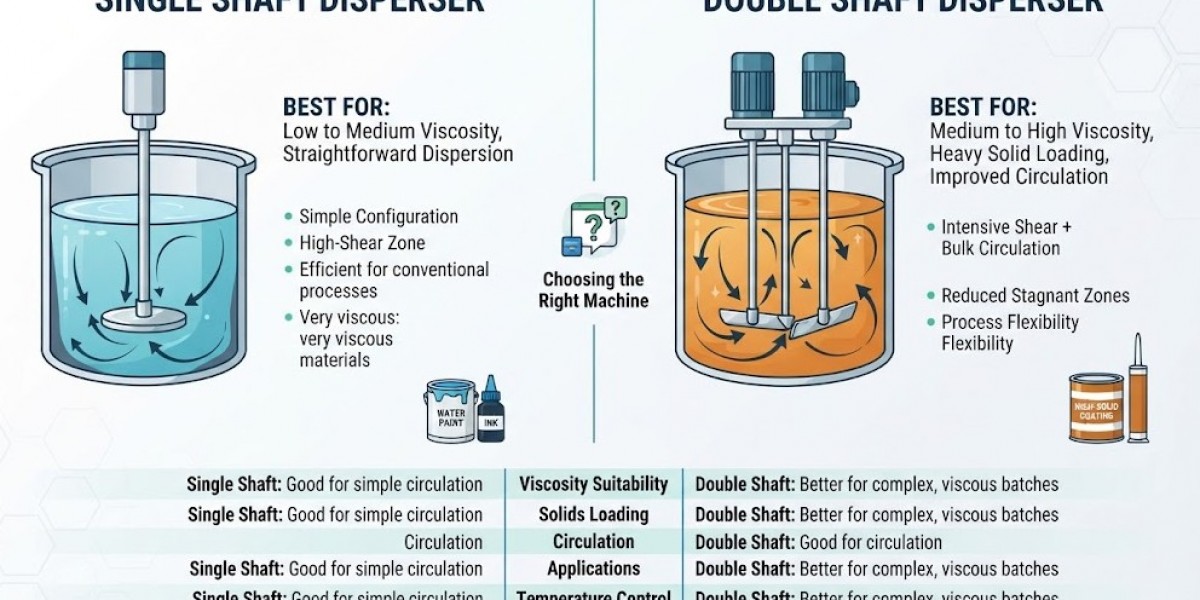
A single shaft disperser typically uses a high-speed rotating shaft equipped with a dispersing disc. The disc generates a localized high-shear zone that helps incorporate powders into liquids and break down particle agglomerates.
This configuration is commonly used for formulations with relatively low to medium viscosity and sufficient natural circulation.
Typical applications include:
Water-based paints and coatings
Printing inks
Pigment dispersions
Liquid chemical formulations
Other relatively fluid industrial mixtures
One advantage of a single shaft disperser is its relatively straightforward mechanical structure. With fewer mixing components, installation, operation, and routine maintenance can be comparatively simple.
However, its performance depends heavily on the material's ability to circulate around the dispersing disc. When processing high-viscosity or high-solid formulations, the movement of material near the vessel walls and bottom may become limited.
Increasing rotational speed is not always an effective solution. Excessive speed can increase heat generation and power consumption without necessarily improving circulation throughout the entire batch.
For this reason, a single shaft disperser is generally more suitable when the formulation can maintain sufficient material movement under the selected operating conditions.
3. Double Shaft Disperser: Combining High Shear with Bulk Mixing
When conventional high-speed dispersion is not sufficient to move a viscous formulation throughout the vessel, a double shaft disperser may offer a more suitable configuration.
A typical double shaft system combines two mixing actions. The high-speed dispersing shaft generates intensive shear to break down agglomerates and improve powder wetting, while the secondary mixing shaft promotes broader material circulation.
This arrangement helps address a common challenge in high-viscosity processing: achieving effective dispersion without leaving large portions of the batch insufficiently mixed.
Double shaft dispersers are particularly relevant to applications such as:
High-solid industrial coatings
Pigment pastes and concentrated colorants
Adhesives and sealants
Fillers and thick chemical compounds
PVC pastes
Casting compounds
Composite materials
For these formulations, the secondary mixing action can help improve material turnover and maintain more consistent processing conditions.
It is important to note that double shaft configurations are not automatically suitable for every high-viscosity material. The appropriate shaft design, rotational speed, vessel geometry, and optional mixing components should be determined according to the formulation's actual rheological properties.
4. Six Factors That Influence Disperser Selection
Viscosity is an important starting point, but relying on it alone can result in an unsuitable equipment choice. Manufacturers should also evaluate several other processing conditions.
1. Solid Content and Powder Characteristics
Formulations containing large quantities of pigments, fillers, or other solid materials may require more effective powder wetting and agglomerate breakdown. Particle size, surface properties, and powder loading can all influence the required dispersion intensity.
2. Batch Volume
As production volume increases, maintaining consistent material circulation throughout the vessel becomes more challenging. Equipment selection should account for vessel dimensions, working capacity, and the movement of material across different areas of the batch.
3. Required Dispersion Quality
Different products have different quality targets. Some applications require general uniformity, while others demand tighter particle distribution and more consistent color development. The required dispersion result should guide the selection of the mixing mechanism.
4. Temperature Control
High-speed mixing generates heat, which may affect temperature-sensitive formulations. Manufacturers should consider whether cooling jackets, temperature monitoring, or automatic temperature control are necessary for the production process.
5. Material Movement Near Vessel Walls and Bottom
Highly viscous materials may move slowly near the vessel wall or bottom, creating areas with insufficient circulation. Depending on the formulation, rotating scrapers or additional mixing components may help reduce material accumulation and improve batch movement.
6. Processing Time and Production Efficiency
The best equipment is not necessarily the machine with the highest rotational speed. A more useful evaluation considers how efficiently the equipment reaches the required dispersion quality while maintaining stable operating conditions and predictable production cycles.
5. Rucca MD Double Shaft Disperser for Industrial Mixing Applications
For manufacturers processing medium- to high-viscosity materials, Rucca offers the MD Double Shaft Disperser, designed for wet dispersion and mixing of liquid-solid systems.
The equipment is used in various industrial applications, including paints, coatings, printing inks, pigment pastes, adhesives, fillers, sealants, PVC pastes, casting compounds, and composite materials.
The MD series supports batch capacities ranging from 30 to 5000 litres, depending on the selected configuration. This range provides options for different production scales and formulation requirements.
Several equipment features support flexible process adjustment:
Frequency-converter speed adjustment: Allows operating speeds to be adjusted according to material characteristics and processing requirements.
Hydraulic lifting system: Facilitates equipment positioning and access to the mixing vessel during production operations.
Optional double dispersing discs: Provide additional configuration possibilities for dispersion processes.
Vacuum processing: Available as an option for applications where reducing entrained air and bubbles is important.
Rotating container-wall scrapers: Help improve material movement near the vessel wall.
Temperature measurement and control: Support monitoring of processing conditions for temperature-sensitive formulations.
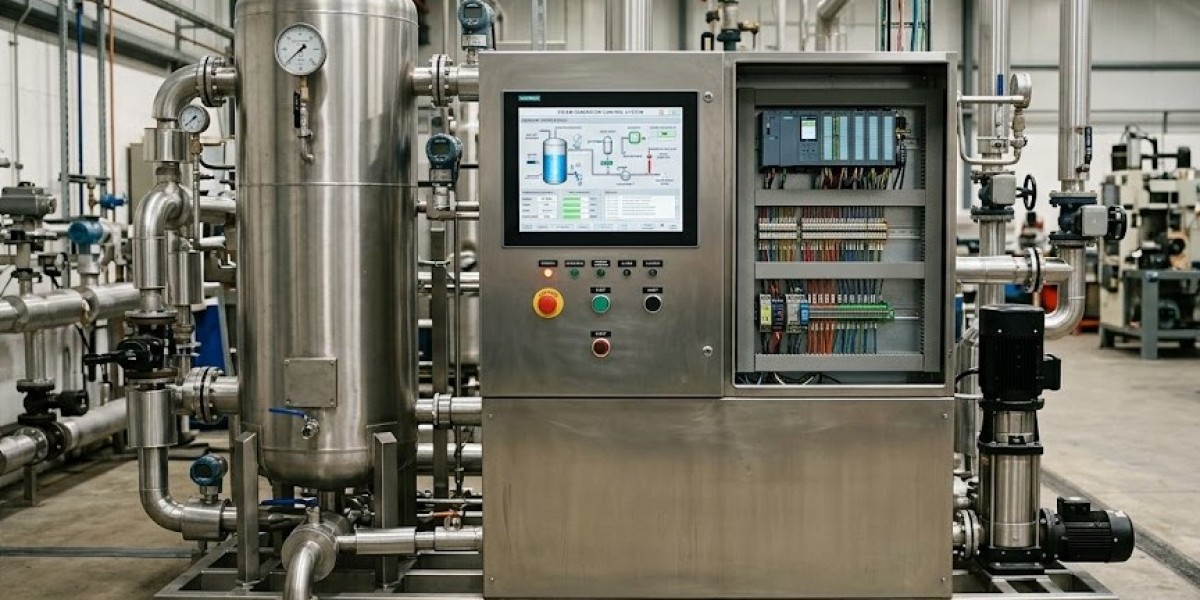
PLC control: Semi-automatic or fully automatic control options can be selected according to production requirements.
Rather than applying one fixed equipment configuration to every formulation, manufacturers can evaluate these options according to their material properties, batch size, and desired production results.
6. Why Material Trials Matter Before Final Equipment Selection
Technical specifications provide an important reference, but they cannot fully describe how a particular formulation will behave during actual production.
Pilot testing is often a valuable step before purchasing industrial dispersion equipment. By processing representative materials under controlled conditions, manufacturers can evaluate several performance indicators:
Whether powders can be incorporated effectively into the liquid phase
How uniformly material circulates throughout the vessel
Whether the required dispersion quality can be achieved
How much heat is generated during processing
The time required to complete each batch
The power and operating conditions needed for stable production
These results provide a more practical basis for determining whether a single shaft or double shaft configuration is appropriate.
Working with an equipment manufacturer that understands formulation requirements can also help identify suitable shaft arrangements, dispersing discs, scraper systems, and control options.
Conclusion
The choice between a single shaft disperser and a double shaft disperser should be based on the characteristics of the material and the requirements of the production process.
For relatively fluid formulations with good natural circulation, a single shaft disperser may provide sufficient high-shear performance with a straightforward equipment structure. For more demanding applications involving high viscosity, high solid content, or difficult material circulation, a double shaft disperser may offer greater processing flexibility by combining intensive dispersion with additional mixing action.
Rucca's MD Double Shaft Disperser provides configurable solutions for industrial wet dispersion and mixing, with batch capacities from 30 to 5000 litres and optional features designed for different formulation requirements.
By evaluating material properties, production capacity, dispersion targets, and actual processing conditions, manufacturers can select equipment that supports more consistent product quality and efficient long-term operation.
https://www.ruccagroup.net/single-shaft-or-double-shaft-disperser-how-should-you-choose.html