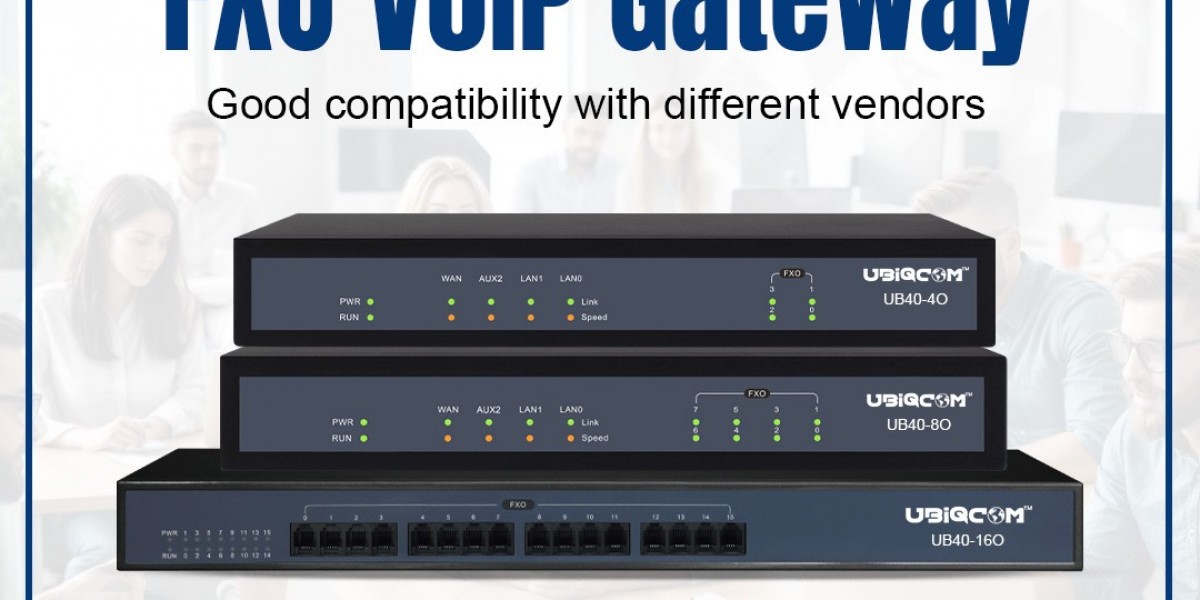

In today’s fast-evolving communication landscape, businesses often find themselves operating in a hybrid environment—where traditional analog telephone lines coexist with IP-based systems. An FXO VoIP Gateway plays a critical role in this setup by enabling seamless integration between legacy PSTN lines and modern VoIP infrastructure. It allows organizations to protect existing investments while gradually transitioning to IP telephony.
Understanding FXO VoIP Gateways
An FXO VoIP Gateway is a device designed to connect analog telephone lines from a service provider to an IP-based communication system. FXO (Foreign Exchange Office) ports are used to receive lines from the public switched telephone network (PSTN). By converting analog voice signals into digital VoIP packets, the gateway ensures compatibility between traditional telephony and IP networks.
This functionality makes FXO gateways especially valuable for businesses that still rely on analog lines for inbound or outbound calling but want the flexibility, scalability, and cost benefits of VoIP.
How an FXO VoIP Gateway Works
The operation of an FXO gateway is straightforward yet highly effective. The gateway connects to analog telephone lines on one side and to an IP network on the other. When a call comes in through a PSTN line, the gateway converts the analog signal into a digital format and routes it through the IP network to an IP PBX or VoIP server. Similarly, outgoing calls from IP phones can be routed through the gateway to traditional phone lines when required.
This bidirectional communication ensures uninterrupted calling, even in mixed-network environments, making the gateway a dependable bridge between old and new technologies.
Key Features and Capabilities
FXO VoIP Gateways are built with features that enhance call reliability and system integration. Most devices support multiple FXO ports, allowing connection to several analog lines simultaneously. They also offer call routing rules, echo cancellation, and voice compression to maintain call quality.
Advanced gateways integrate smoothly with an IP PBX, supporting standard VoIP protocols such as SIP. This ensures easy deployment within existing network architectures and compatibility with a wide range of IP-based communication platforms.
Benefits of Using an FXO VoIP Gateway
One of the primary advantages of an FXO gateway is cost efficiency. Businesses can continue using existing PSTN lines while reducing dependency on traditional telephony hardware. It also provides redundancy—if the IP network faces issues, calls can still be routed through analog lines.
Another significant benefit is flexibility. Organizations with multiple branches or remote locations can centralize call handling while still leveraging local PSTN connections. This hybrid approach improves operational continuity and simplifies communication management.
Common Use Cases
FXO VoIP Gateways are widely used in small to medium enterprises, call centers, and service providers. They are ideal for businesses migrating from legacy phone systems to VoIP in phases. Enterprises with backup analog lines also rely on FXO gateways to ensure business continuity during internet outages.
In regions where IP telephony adoption is still growing, FXO gateways help businesses maintain reliable communication by integrating local PSTN connectivity with modern VoIP solutions.
Choosing the Right FXO VoIP Gateway
Selecting the right gateway depends on factors such as the number of analog lines required, compatibility with existing systems, and future scalability. It is important to evaluate call volume, network capacity, and support for essential VoIP features before deployment.
A well-chosen FXO gateway not only simplifies integration but also enhances overall communication efficiency, making it a strategic component of any hybrid telephony setup.
Conclusion
An FXO VoIP Gateway is a practical and reliable solution for businesses operating in mixed telephony environments. By enabling seamless interaction between PSTN lines and IP networks, it ensures smooth communication, cost savings, and long-term scalability. As organizations continue to modernize their communication infrastructure, FXO gateways remain a key enabler in bridging the gap between traditional and IP-based telephony.