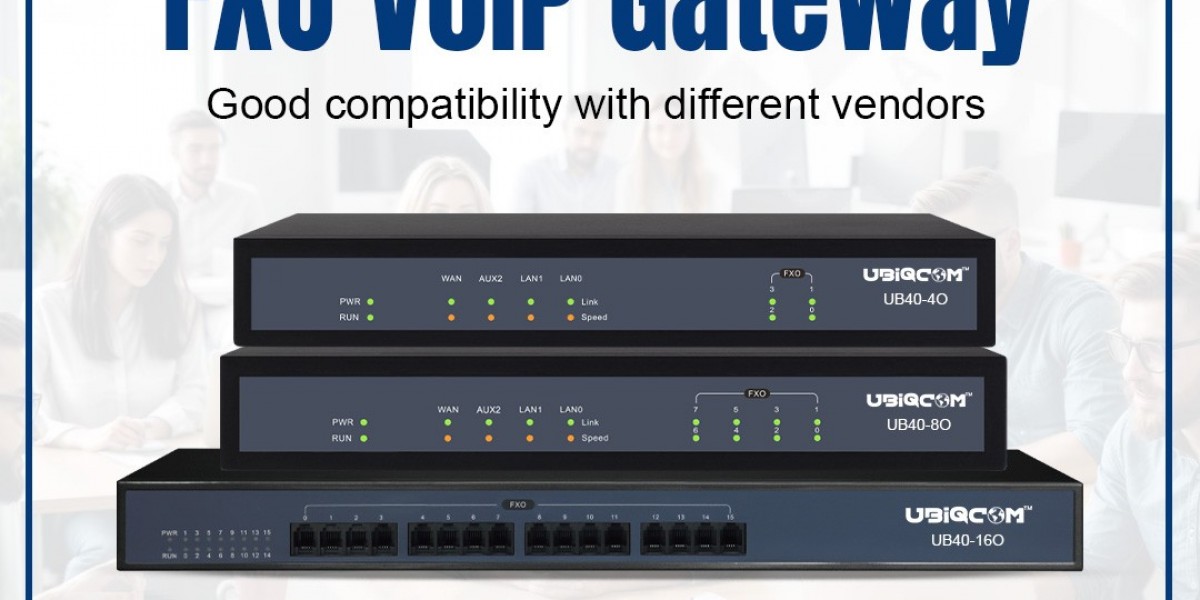

As businesses transition from legacy phone systems to IP-based communication, the challenge often lies in integrating existing analog lines with modern VoIP networks. This is where an FXO VoIP Gateway plays a critical role. It acts as a bridge between traditional PSTN lines and IP-based systems, enabling organizations to migrate smoothly without discarding their existing infrastructure. From cost efficiency to operational flexibility, FXO gateways remain highly relevant in today’s hybrid communication environments.
What Is an FXO VoIP Gateway?
An FXO (Foreign Exchange Office) VoIP Gateway is a device designed to connect analog telephone lines from a telecom provider to an IP-based PBX or VoIP network. In simple terms, it allows traditional PSTN lines to communicate with a VoIP system.
The FXO port behaves like a telephone from the perspective of the telecom operator. It receives dial tone, incoming calls, and signaling from the PSTN, converts them into IP packets, and routes them through an IP PBX, softswitch, or SIP server.
How an FXO VoIP Gateway Works
When a call comes in from a traditional phone line, the FXO gateway receives the analog signal and converts it into digital VoIP data. This data is then transmitted over the IP network to the VoIP system, where it can be routed to IP phones, softphones, or even remote offices.
For outgoing calls, the process is reversed. The IP PBX sends the call to the FXO gateway, which converts the digital signal back into analog format and sends it to the PSTN line. This two-way conversion enables seamless communication between old and new telephony technologies.
Key Components and Features
An FXO VoIP Gateway typically includes multiple FXO ports, depending on the number of analog lines required. Common features include:
Support for SIP and other VoIP protocols
Echo cancellation for improved call quality
Caller ID detection and transmission
Call routing and failover capabilities
Compatibility with popular IP PBX platforms
Advanced models may also support T.38 fax, line polarity reversal detection, and detailed call logs for monitoring and billing.
Why Businesses Still Use FXO VoIP Gateways
Despite the growth of pure SIP trunking, FXO gateways remain valuable for many organizations. In regions where SIP services are unreliable or expensive, analog lines are still widely used. An FXO gateway allows businesses to retain these lines while benefiting from IP-based call management.
They are also commonly used as a backup solution. In case the internet connection fails, incoming calls can still be received through PSTN lines, ensuring business continuity. This makes FXO gateways a practical choice for enterprises that prioritize reliability.
Common Use Cases
FXO VoIP Gateways are deployed across various industries and scenarios:
Small and medium businesses migrating from analog PBX to IP PBX
Enterprises maintaining PSTN lines for redundancy
Call centers integrating local analog lines with centralized VoIP systems
Hotels and hospitals where legacy telephony infrastructure is still in use
These gateways help organizations modernize communication without a complete overhaul.
Benefits of Using an FXO VoIP Gateway
One of the biggest advantages is cost optimization. Businesses can continue using existing analog lines while gradually transitioning to IP-based services. There is no immediate need to replace all infrastructure, which reduces upfront investment.
Another benefit is flexibility. Calls can be routed intelligently between PSTN and IP networks based on cost, availability, or call type. This hybrid approach provides better control over communication workflows.
Conclusion
An FXO VoIP Gateway is a practical and efficient solution for organizations operating in mixed telephony environments. By connecting traditional PSTN lines with IP-based systems, it enables a smooth transition to modern communication without disrupting existing services. Whether used for migration, backup, or hybrid deployments, FXO gateways continue to be a reliable component in business telephony architectures.